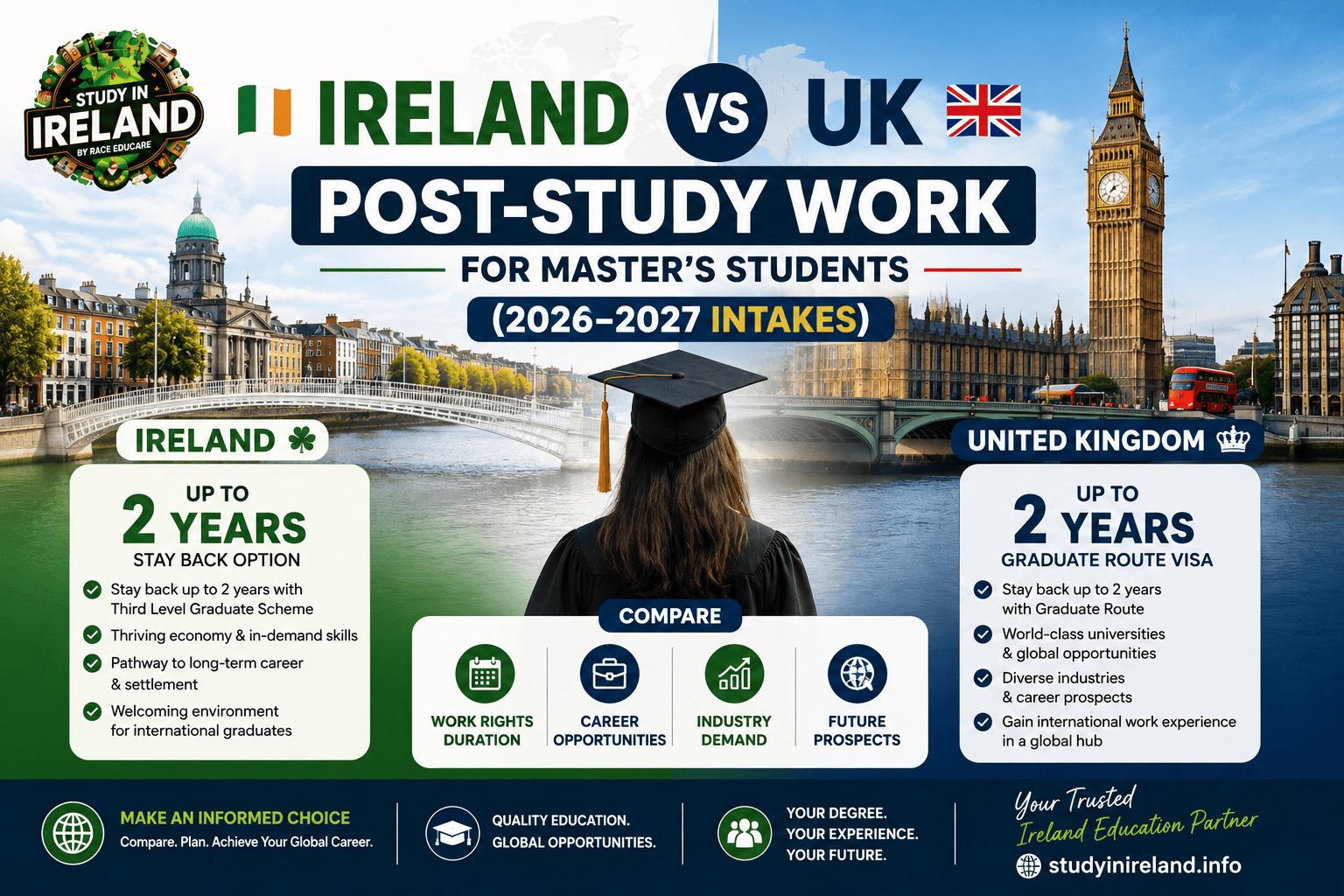
Ireland gives Master’s students up to 2 years of flexible, unsponsored post‑study work (Stamp 1G), with clear routes into skills‑based work permits and long‑term residency. The UK also offers post‑study work, but future duration and sponsorship rules can be more changeable. For many MSc students from Nepal and South Asia, Ireland is a cleaner, more predictable pathway from Master’s → work experience → long‑term options.
Length of Stay-Back After a Master’s
- Ireland
- Master’s / Level 9 graduates can typically stay up to 24 months on the post‑study work scheme (Stamp 1G).
- This is usually granted as 12 months first, then a 12‑month extension if you show active job‑search or employment.
- UK
- Under the current Graduate Route, Master’s graduates usually get around 2 years of post‑study work.
- There are discussions and projections that UK length could tighten to around 18 months from 2027 in some comparison guides, while Ireland remains at 2 years.
For MSc students, Ireland gives a very competitive (and often more stable) 2‑year window, especially useful if you need extra time to find the right job and build experience.
2. Sponsorship Requirement During Stay-Back
- Ireland (Stamp 1G)
- You can work full‑time (up to 40 hours/week) without needing employer sponsorship during the stay‑back period.dublinisc+1
- You are free to change jobs and explore different roles while you decide on your long‑term path.poststudywork+1
- UK Graduate Route
- Similarly, graduates can work without sponsorship during the Graduate Route period.
So in both countries, the post‑study phase is unsponsored and flexible, but Ireland’s combination of 2‑year Stamp 1G plus later Critical Skills routes makes it very attractive for STEM/business MSc students.
3. Pathways After the Post-Study Period
- Ireland
- After Stamp 1G, many graduates aim for a Critical Skills Employment Permit or a General Employment Permit.nomadcredit+1
- Critical Skills can lead to Stamp 4 (long‑term residency) after some years of work, giving more stability and EU mobility.
- UK
- After the Graduate Route, students usually need an employer‑sponsored work visa (like a Skilled Worker visa).wheretoemigrate+1
- Long‑term stay depends heavily on employer sponsorship and meeting salary/occupation criteria.
For an MSc graduate who wants a clear, skills‑based route into longer‑term work and residency, Ireland’s Critical Skills + Stamp 4 pathway is designed explicitly around graduate talent.
4. Strategic Fit for MSc/Postgraduate Students
- If your main goal is:
- “Do a 1‑year Master’s + get 2 full years of unsponsored work rights + then move into a skills‑based permit with a path to long‑term stay”
- → Ireland is structurally very attractive.
- If your goal is more:
- “Use the post‑study period as a short bridge into a sponsored job, in a very large job market with many cities”
- → The UK can be strong because of its size and diversity, but your ongoing stay depends more heavily on sponsorship rules.
Have questions about this topic?
Talk to an Expert
 Careers