 Careers
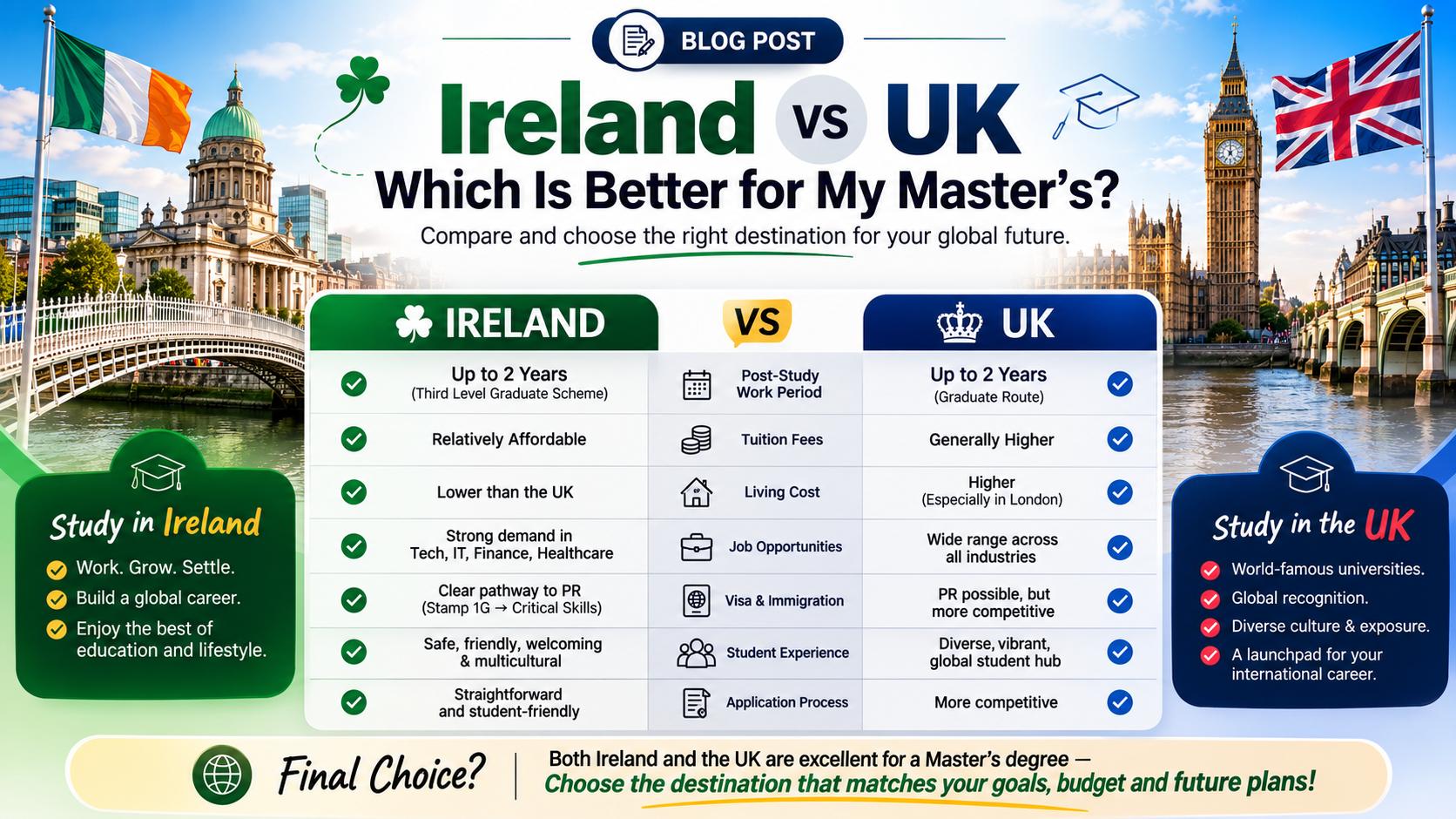
Ireland vs UK: Which Is Better for My Master’s?
1. Post-Study Work and Stay-Back
- Ireland
- Typically offers up to 2 years post‑study work for many Master’s (Level 9) graduates via its stay‑back scheme.
- Good alignment with tech, data, pharma, engineering and business roles, so MSc grads in these areas can use those 2 years effectively.
- UK
- Also offers around 2 years post‑study work for many graduates on the current Graduate Route.
- Larger and more diverse job market across finance, creative fields, media, and wider industries.
From a pure stay‑back perspective, Ireland and the UK are similar for Master’s, but Ireland is particularly attractive for STEM and business students who want a focused, high‑demand tech/analytics environment.
2. University Landscape and Admission Competitiveness
- UK
- Much larger system with many universities and famous “top tier” names.
- Highly competitive entry for the most famous institutions, but also a wide range of mid‑tier options.
- Ireland
- Smaller system, but with well‑ranked universities and strong specialized programmes.
- Top Irish universities are often more accessible admission‑wise than the very top UK universities, especially if students apply early and have a good profile.
For many Nepali/South Asian MSc students, Ireland offers a simpler shortlist of strong universities rather than hundreds of options, which actually makes decision‑making easier.
3. Costs and Lifestyle
- Tuition and living costs vary a lot within both countries:
- Capital cities (London, Dublin) are expensive in both.
- Smaller cities/towns in the UK can sometimes be cheaper than Dublin; Ireland has fewer big cities but often slightly higher rents in Dublin.
- Ireland generally gives:
- Smaller, more close‑knit student communities.
- A reputation for being very friendly and safe, which can be reassuring for first‑time international students.
If students are ready for Dublin-level cost and want a compact, safe environment with a clear tech/business focus, Ireland fits well. If they want lots of city choices and a very broad job market, the UK offers more variety.
4. EU Access and Long-Term Mobility
- Ireland is in the European Union, which matters for long‑term planning:
- Over time, if a graduate builds a path to Irish residency/citizenship, they gain mobility across EU countries.
- UK is outside the EU now:
- Still strong academically and economically, but EU‑wide mobility is more limited than it used to be.
For MSc students who think strategically about future Europe-wide opportunities, Ireland has an edge for long‑term EU access.
5. Ireland vs Other European Countries (Germany, Netherlands, etc.)
Compared to many other European study destinations:
- Language
- Ireland: English for teaching, daily life and work.
- Many EU countries: strong universities, but local language often needed for jobs and daily life.
- Post‑study work clarity
- Ireland: relatively simple, well‑known stay‑back scheme for Master’s.
- Other European countries: good opportunities, but rules can be more complex or language‑dependent.
- Job market fit
- Ireland is particularly strong for IT, data, pharma, and finance, with lots of European HQs.
- Other countries may be cheaper for fees or living, but can require stronger local language skills.
For MSc/postgraduate students from Nepal and South Asia who prefer English + clear stay‑back + EU access, Ireland is often easier to navigate than a non‑English‑speaking European country.
Have questions about this topic?
Talk to an Expert